HealthTech — Mental Wellbeing — Case Study
Client
SuperBetter
Industry
HealthTech — Mental Wellbeing
Team
Product Transformation, Design Transformation, Tech Transformation
The Challenge
SuperBetter began as one person's own recovery process. In 2009, game designer Jane McGonigal suffered a severe concussion, and rather than wait passively to heal, she turned her recovery into a resilience-building game of her own design, tracking quests, power-ups, allies, and "bad guys" the way a game designer would track any other system. Those personal rules became a blog, then a digital game, then a New York Times bestselling book, and eventually a platform that more than a million people have used to build resilience against anxiety, depression, chronic pain, and concussion recovery.
That growth, from one person's private coping system into a platform used by individuals, classrooms, and clinical researchers, created real product tension. A tool built around one person's personal quests needed to simultaneously serve a teenager working through anxiety alone on a Hero account, a teacher running a five-day squad challenge for an entire classroom on a Host account, and a researcher measuring outcomes in a controlled study, without the experience losing the warmth and hopefulness that made it work as a game in the first place, or the scientific rigor that had earned it a randomized controlled trial at the University of Pennsylvania and recognition from the World Economic Forum.
Our Approach
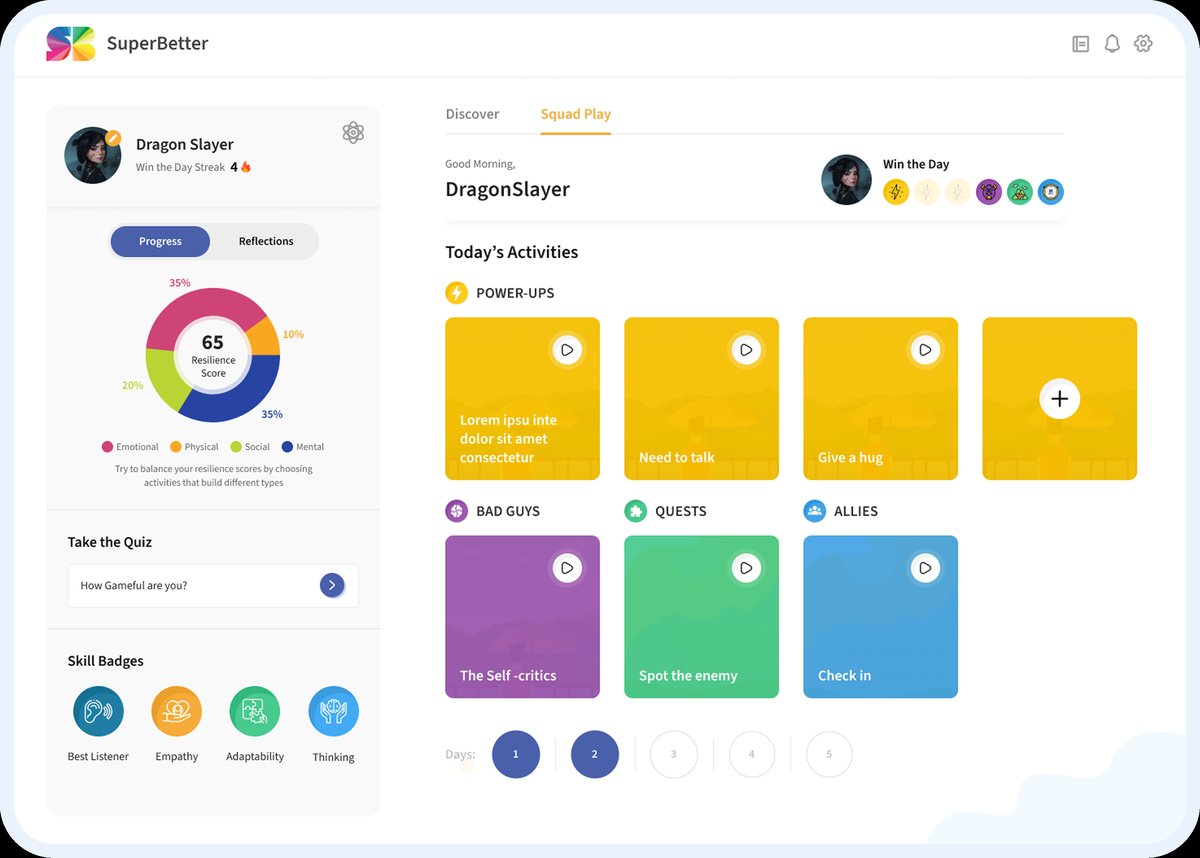
We restructured the core product around the three ways people actually use SuperBetter: playing alone on a Hero account, hosting squad challenges for a group on a Host account, and joining a challenge as a Player. Each mode needed its own pacing and depth without fragmenting into three separate products, since a teacher hosting a classroom challenge and a student playing solo both needed to recognize it as the same SuperBetter.
Mental health products often default to a clinical, muted visual language. We kept SuperBetter's design deliberately gameful instead, quests, power-ups, and epic wins rendered with the warmth and momentum of an actual game, because the psychological mechanism SuperBetter is built on depends on the experience feeling like play rather than treatment.
Squad challenges, classroom deployments, and research studies all place different demands on the underlying platform than a single person playing alone. We rebuilt the technical foundation to support structured, multi-day squad challenges and outcome tracking suitable for peer-reviewed research, without slowing down the simple, personal experience that most Hero account users interact with every day.
Technologies Used
The Result
SuperBetter has now been played by more than a million people and is backed by ten peer-reviewed studies showing improvements in resilience, self-efficacy, anxiety, and depression, including a randomized controlled trial at the University of Pennsylvania. The World Economic Forum named SuperBetter a Top Innovator in Youth Mental Health, and Jane McGonigal's TED Talk introducing the underlying research has been viewed more than nine million times.
The platform now runs across a library of more than ninety squad challenges, alongside a growing SuperBetter Classroom program used by teachers to bring social-emotional learning into schools. Because the Hero, Host, and Player account structure was built to serve each use case properly rather than forcing one experience to fit all three, SuperBetter has been able to grow from an individual wellbeing tool into infrastructure for classrooms and research studies without diluting what made it effective in the first place.
Platform Users